Bee Freebie

Bees love a freebie. They will bypass a flower full of nectar to suck a drop of honey off the ground. It’s much more efficient to gather pure honey than to turn watery nectar into honey by digesting it, regurgitating it into a wax honeycomb cell, fanning it until it reaches the right consistency, then sealing it with more wax to cure.

The honey bee’s sucking tube, or proboscis, is a long, slender, hairy tongue that acts as a straw to bring liquid to the mouth. It’s assembled from two separate organs, the maxillae and the labium. The bee opens its mandibles and folds the two organs into a tube when it needs to suck, and then quickly moves the proboscis up and down while lapping with the flexible tip.

Wanna see it?

All Hear The Queen

queenbee

           Queen bees make a signature sound, a “toot” that has been described as a quack or a mouse squeak, also known as “piping.” They make this noise for a variety of reasons, it can be a sign of distress, or a warning to rivals to vacate the premises. I’ve heard queen bees make this noise when they are being artificially inseminated in a lab (ouch), and also when they are incubating inside a wax cell and want to communicate with the colony. When there are many  queens ready to hatch at the same time in one hive, they use this call to intimidate other queens, think of it as, “As soon as I hatch outta here, I am going to kick your ass and take the throne.” Take a listen, and see what you think. The sound was captured by British beekeepers, and sent via by my Petaluma beekeeper friend Aerial Gilbert.

Listen inside a beehive

DSC_1665Decades ago, my friend Aerial Gilbert (right) was a beekeeper. She loved the sight, smell and feel of bees in her hands – like any crazy beekeeper will try to convince you is a magical thing.
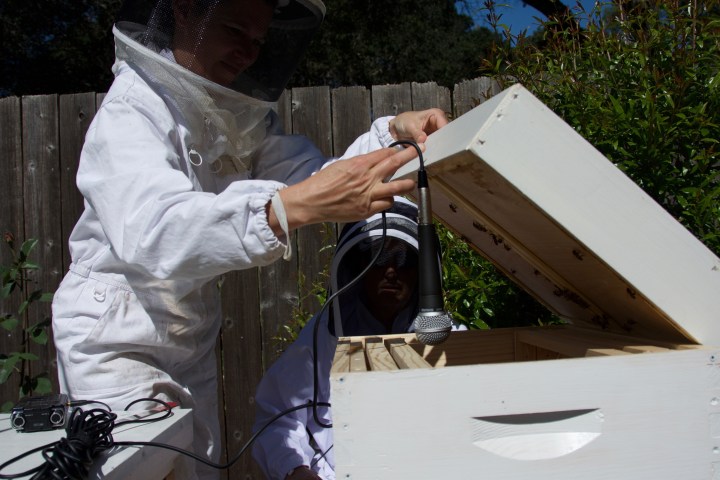

When Aerial lost her sight, she had to forego some things – only a few – for safety. After living with bees for eighteen years, she tearfully gave her hives away. But now, she’s ready for a comeback. She joined the Sonoma County Beekeepers Association and got a beekeeper buddy to help her.

She’s wearing the white suit again, and overjoyed with two new hives in her backyard.

When she told me she listens to her hive with a stethoscope, I got an idea. I have some professional sound recording equipment. Why not drop a mic in and find out what it sounds like in there?

DSC_1634

And that we did. We heard the ping of bees landing on the wire mesh bottom screen. We heard fanning that sounded like a jet fighter. And we heard the hum of a super-organism, a collective happy sound that all is good in the family. Take a listen yourself.

DSC_1606 DSC_1657

We plan to keep testing with different microphones, so stay tuned for sound updates on this blog.