Goodbye to the Beekeeper of Big Sur

FranklinPeace

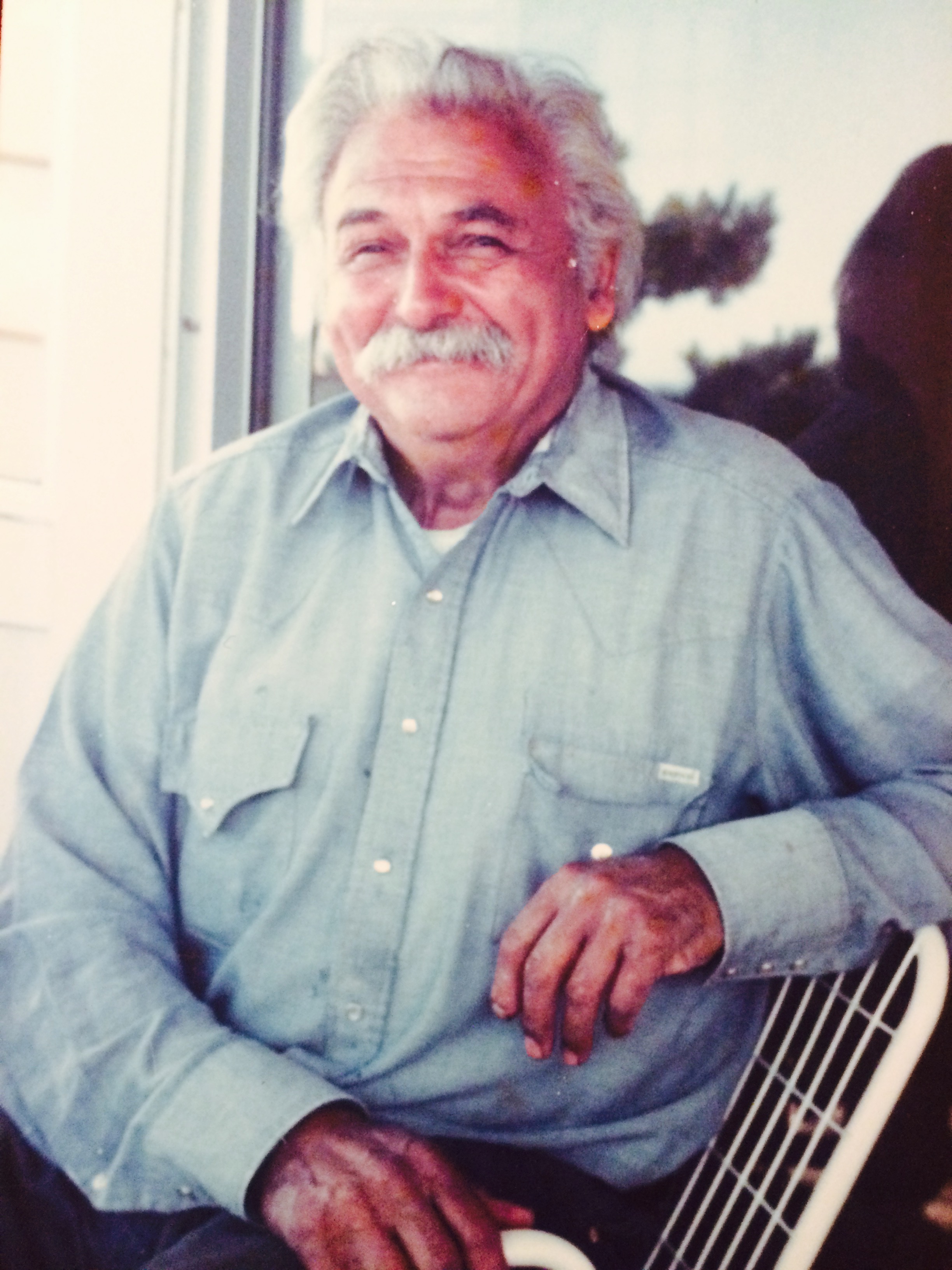
E. FRANKLIN PEACE 1926-2015

E. Franklin Peace, a longtime Big Sur beekeeper and direct descendant of the area’s early pioneers, died in his sleep on May 31. He was 89.

Mr. Peace’s great great-grandfather was William Brainard Post, for whom the Post Ranch is named, who left Connecticut to settle in Big Sur in the 1850’s. Post married Anselma Onesimo, a Native American woman of Rumsien Ohlone (Coastanoan) descent whose ancestors helped Junípero Serra build the Carmel Mission. Mr. Peace’s grandfather was Edward Grimes, another 19th century ranching family on the coast, that emigrated from England.

For nearly 70 years, Mr. Peace kept more than one hundred hives in the Garrapata and Palo Colorado Canyon areas of Big Sur, as well as in the nuns’ garden at the Carmelite Monastery. He produced up to three tons of honey a year, and made deliveries to Big Sur grocery stores, restaurants and residents in his rambling pickup truck.

A lifelong Monterey County resident, Mr. Peace was born in the Monterey Hospital in 1926, and joined the U.S. Navy the day after graduating from Monterey High School. He served in Guam from 1944-1946.

His passion for bees began at age 14, when his father caught a swarm in their Pacific Grove backyard. Father and son bought a wooden box hive for the colony, which quickly expanded to five hives, until his mother put her foot down. They relocated the bees to a cousin’s ranch in Big Sur, but not before leaving one hive on the front porch of the house next door. Their neighbors, who were Japanese, were taken to World War II internment camps and Mr. Peace and his father used the bees to successfully protect the home until their friends returned.

After the war, Mr. Peace bought a decommissioned Army bus from the Fort Ord military base and renovated it into a portable honey rig; tearing out all the seats and installing a honey spinner so he could extract and bottle honey in the fields next to his Big Sur apiaries.

In his teens and early twenties, Mr. Peace also worked as a sardine fisherman on Cannery Row, using a skiff boat to haul in nets of fish. He also worked inside the canneries, rolling large steel crates of canned sardines into a steam cooker to seal the tins.

When the sardine population began declining in the mid-fifties, Mr. Peace relocated to Big Sur to apprentice under builders Frank and Walter Trotter. For the next eight years, the brothers taught Mr. Peace ranching, construction and plumbing. Mr. Peace became a well-known plumber in Big Sur, once climbing the steep Santa Lucia Mountains to build a gravity-fed water system that directed water from a natural spring to Nepenthe restaurant.

When he was 37, Mr. Peace met a schoolteacher he fancied while square dancing. Two years later, during a hoedown in Nevada, Mr. Peace and Ruth Miller dashed out to a courthouse to get married, asking a stranger in the building to serve as their witness. They settled in Carmel Valley, where he lived ever since.

Mr. Peace was a well-known storyteller and patient teacher who mentored many people in the beekeeping profession. He once summed up his love of beekeeping:

“I’m social. I like to talk. The best thing is talking to people about bees. People want to know if I’m having a good year, how many pounds of honey. People don’t know a lot about bees, but they are very curious. I tell them I have to take care of the bees and put them in a place where they can fly free.”

Mr. Peace is survived by his wife, Ruth; sister Ellanah Plain of Concord; step-son Stephen Rial of North Fork, step-daughter Sally May of Carmel Valley; five step-grandchildren: beekeeper Meredith May (and this blogger) of San Francisco, Matthew May of San Mateo, Shelley Billante of Las Vegas, Wendy Wallace of North Fork, and Jessica Hansen of North Fork; and nephew Craig Plain of Concord; and niece Cindy Terry of Danville.

No immediate memorial services are planned.

Donations in his name may be sent to the Big Sur Historical Society, P.O. Box 176, Big Sur, CA, 93920; or to the Carmel Valley Library, 65 W. Carmel Valley Rd., Carmel Valley, CA 93924.
Flight Plan

Every hive has a distinct flight plan – a certain place on on the landing board where the bees prefer to land and takeoff. One of my hives prefers the right corner. The other hive is less specific, with the bees landing and taking off anywhere near the entrance.

Today I took a seat on an old tire facing the right-dominant hive, and watched the bees to see if I could get a sense of which way they were going for nectar. They flew out, straight toward me, then rose up and over a fence several feet behind the hive, toward a basketball backboard. Then they banked left and flew toward a tree with white flowers and red berries. Returning, they made the same Blue Angels sudden turn, but in reverse. Show-offs.

Bee Cloud
Bee Cloud

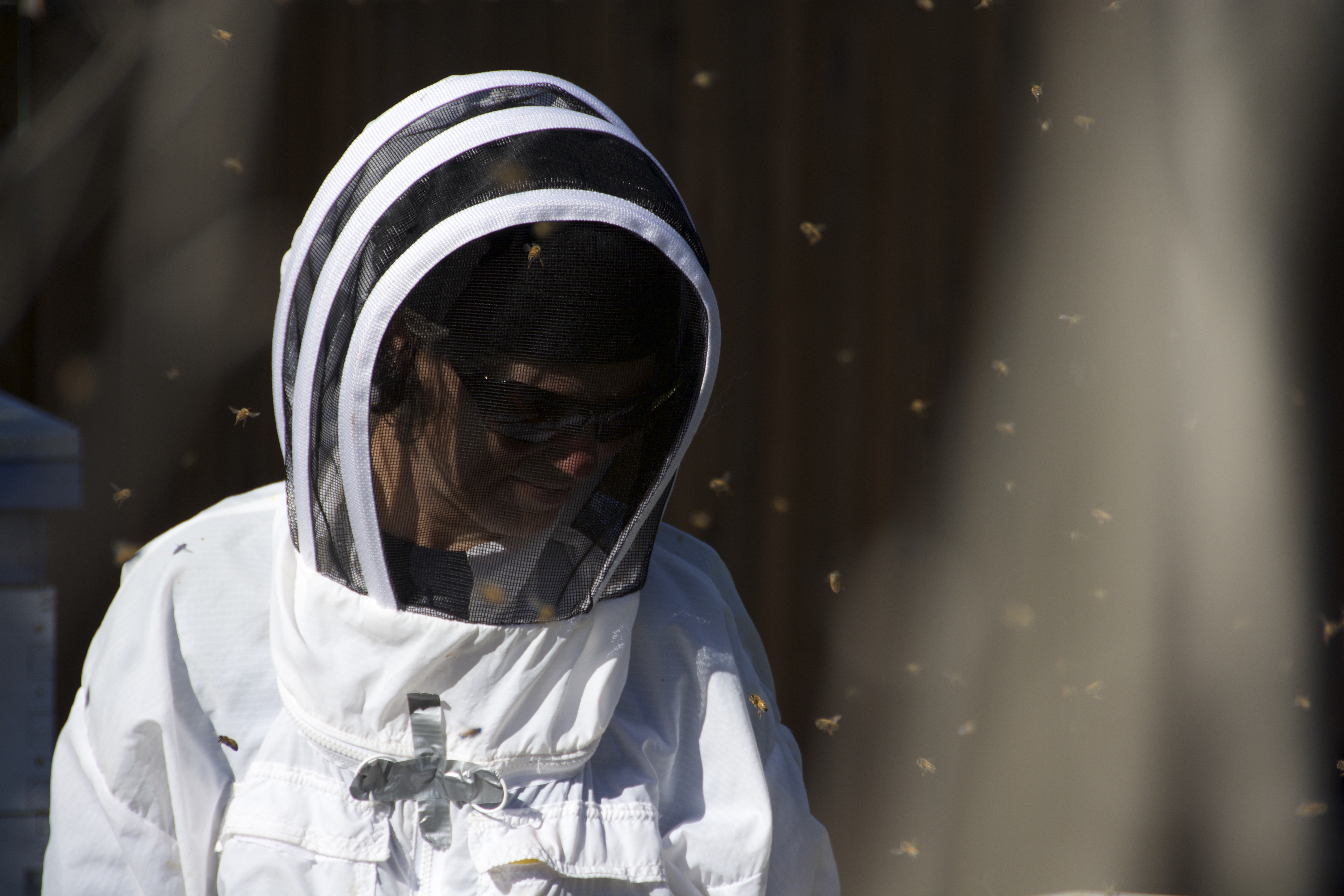
I know this sounds strange, but the most soothing place for me is sitting in a cloud of bees. Their hum is like an “ohm,” and when I am alone with them, time slows down and I finally notice the pulsing microcosmos all around me. Today I saw that many of my foraging bees wipe their antennae clean just before they takeoff. Always important to look presentable before you leave the house, right?

The Queen Lays an Egg

The Queen and her retinue, photo by MaryEllen Kirkpatrick

It’s always fascinating to watch the Queen Bee at work, laying more than 1,000 eggs a day. She’s picky about her nursery, ambling along the honeycomb and inspecting each hexagon cell to make sure it’s clean, air-tight and worthy of her offspring.

She reminds me of a duck nibbling something underwater, sticking her head in the cell so just her butt remains visible. When she finds a space to her liking, she squats and puts her long abdomen inside, lays and egg, and then does a pushup with her long legs to exit.

Watch her lay an egg below. 

The Queen is an egg-laying machine, in constant motion. But I took the few seconds when she was still, laying her egg, to mark her with a small dot of blue paint. This helps me find her more easily during hive inspections, and also helps me know important things, such as whether she has been overthrown. Each year beekeepers use a different color for the Queen. In 2015, her heiness wears royal blue.

Why Bees Smell Like Lemon

IMG_2700

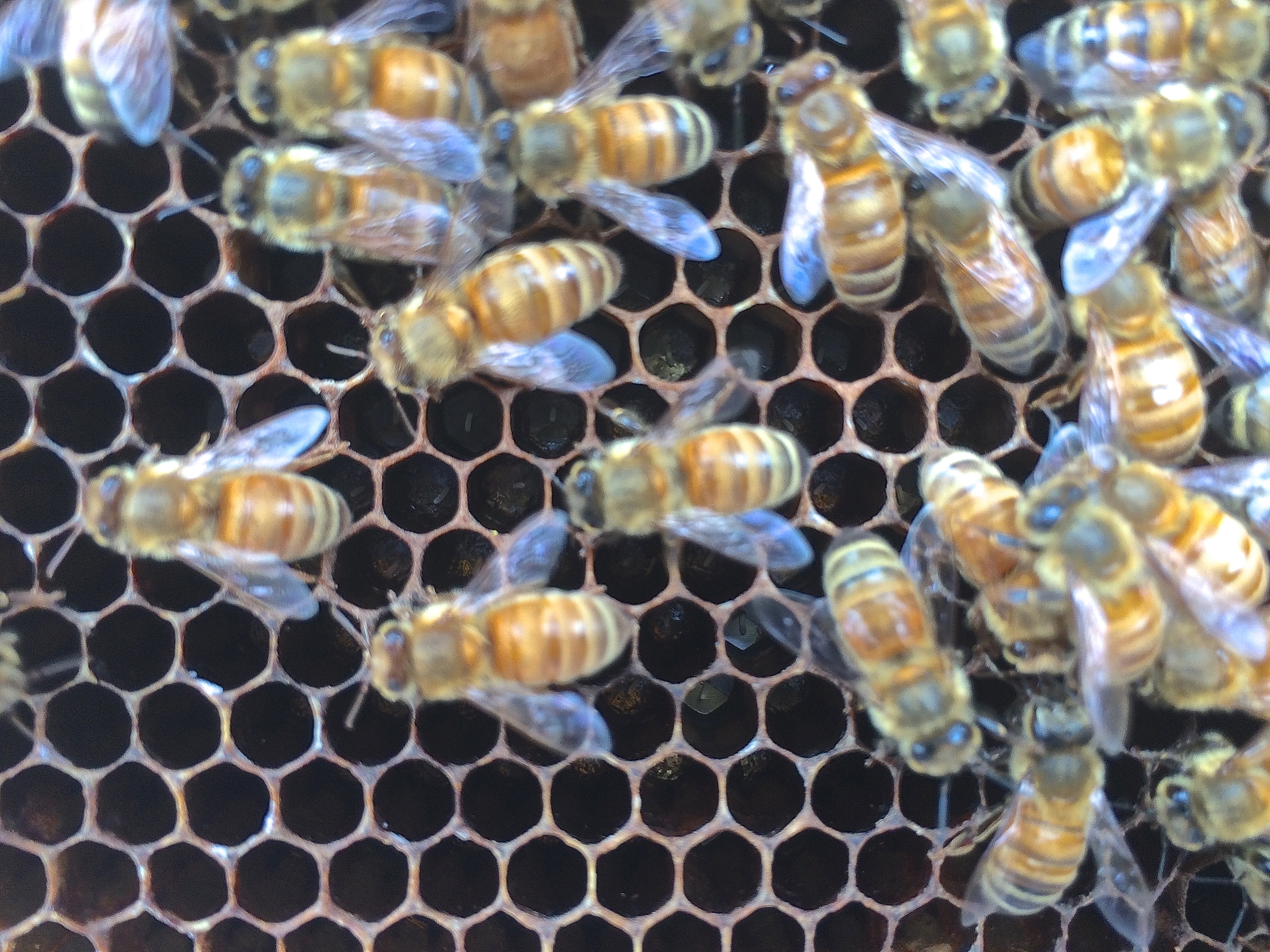
Being that this is Easter season, I went on an egg hunt of sorts today, checking to see if my new queen bee is laying eggs. Huzzah! Look in the cells between the four bees on the left-hand side of this photo. You might need to click on the photo to enlarge it. See some small white pins that look like rice? Bee eggs! Proof Her Majesty is going to work, laying up to 1,500 eggs a day.

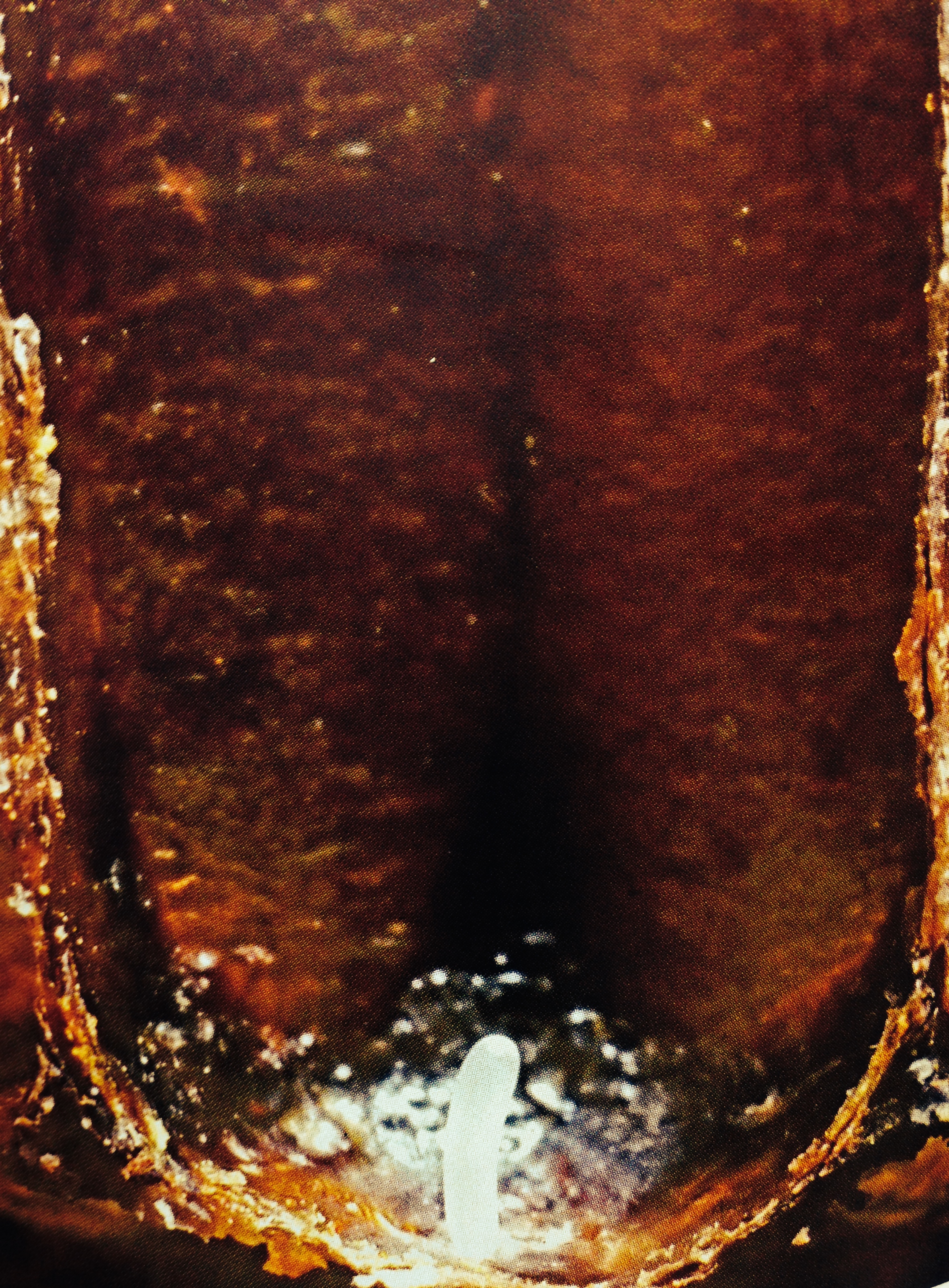
When I closed the hives, I spotted a handful of bees fanning their wings madly at the entrance. Bees can flap their wings more than 200 times per SECOND. Watch it on slo-mo video, where you can see the bees bend the tips of their abdomens to expose their Nasanov glands. The gland releases a lemon-scented attraction pheromone that helps foraging bees smell their way home. Think of it as sprinkling lemongrass on your doorstep to ensure that your family members remember which house is theirs.

Now if you smell bananas, you’ve got an entirely different problem. More on that in a later post …

Springing the Queen

queenbee

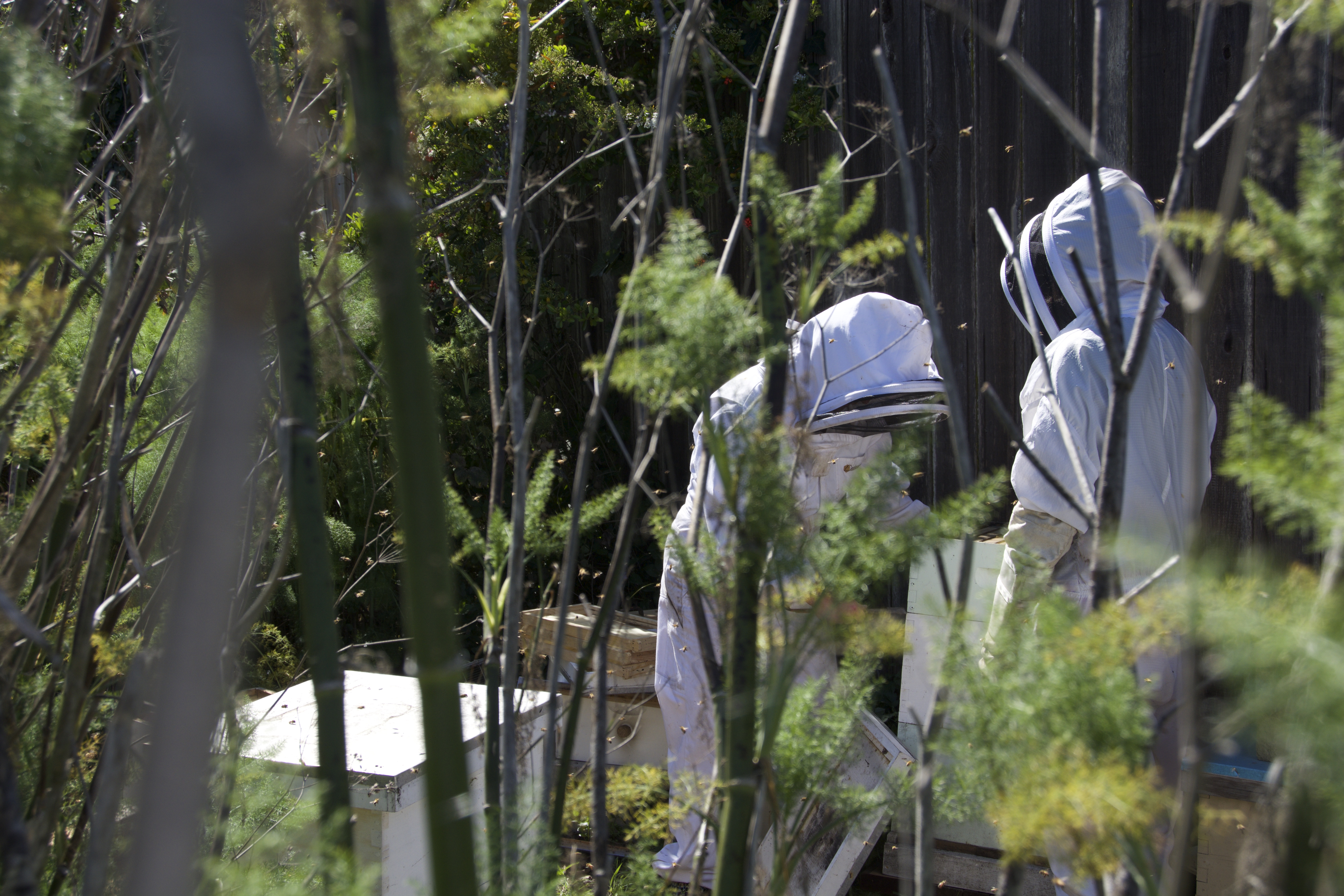
It’s been three days since we installed four new beehives at Little City Gardens in San Francisco – enough time for each colony to start foraging in the tall fennel and blackberry vines and become accustomed to the scent of their new Queen. So we returned to the bee yard to release the Majesties from their confines. Rather than jabbing the cork plug of her cage and pulling to release her, which might unintentionally injure her, we pried open the staple and screen from the side of her cage and let her amble out. Here’s a video of the process; listen closely and toward the end you can hear the Queen “pipe” — make a squeak to announce her arrival. It’s like a bee version of, “Yo!”

DSC_7984

I prefer “controlled release” because you know for sure the queen is healthy and the bees like her before she’s let go. Putting a sugar plug or marshmallow plug in her cage isn’t as secure, because if you show up to an empty cage after the bees chew through the sugar, you’re never certain if they ate through it too fast and killed her, or if she died in the cage and the bees flew off with her to dispose of her far from the hive. You’ll discover it eventually when no eggs appear, but by then you’ve lost precious time to correct the situation.

Next up: We return in five days to look for eggs in the honeycomb. To know The Lady Doth Bear Fruit.

IMG_0762